


Home • Conference • News • Resources • Science • History • Autism • Bookshelf • Membership • Contact Us

What about Rapid Prompting Research?
Good question. If Rapid Prompting worked as well as its advocates claimed it does, with hundreds of successes, the scientific journals would be full of methodologically sound demonstrations of previously nonverbal people suddenly and unambiguously typing their very own thoughts. There is no such body of research.
The reality is that there is only one empirical analysis explicitly targeting Rapid Prompting. Unfortunately, its authors did not even try to validiate the communications attributed from their subjects. That is, they simply assumed the communications were authentic at the outset, then claimed they were real at the end. What they really found was that over time the subjects seemed to engage more with the Rapid Prompting task. Of course, that does not mean the subjects had any kind of conventional understanding of it as language.
Room Arrangement Implications
The physical configuration of the teaching setting can have profound effects on the efficiency of teaching. The benefits of certain arrangements over others should not be underestimated. There is even a literature on this.
However, the RPM tactic of placing subjects in a corner suggests a serious deficit in the RPM scheme: because most of the subjects will not understand what is being done or said, the tasks are unlikely to be interesting to them. Being anywhere else will be better than being at the table. Escape will become the dominant response. Of course, escape is not possible because someone is in the way.
This will work. Eventually, escape attempts will extinguish because the child cannot get out. However, there is a much better way.
In Applied Behavior Analysis, we would recognize that the need to physically restrain the learner in this manner means that we have failed to find and use effective reinforcers, and failed to select tasks that are associated with reasonable rates of reinforcement. If physically blocking the subject had to be done, it could be nothing more than a temporary expedient. And, because we recognize that learned helplessness is unlikely to lead to good engagement with the learning situation, the need physically block escape cause us to make immediate modifications to the teaching program.
In other words, if we discovered that we were boring the subject to the point that anything is better than what we are doing, we should expect escape. The problem is to our's, not the child's.
BAAM Special Feature
What is the Rapid Prompting Method?
by
James T. Todd, Ph.D.
(Eastern Michigan University)
The Rapid Prompting Method is a type of Facilitated Communication (FC) attributed to Soma Mukhopadhyay of India in which pointing-, typing-, or writing- based expressive communication is simulated in a non-verbal person by a facilitator who provides gestural, verbal, or other non-physical cues for the communications.
In a typical instance of Rapid Prompting, the facilitator holds a printed letterboard or typing device in the air in front of the subject, moving it about as words and sentences are spelled out letter-by-letter. It is also possible to use RPM to teach the subject to seemingly write or type independently, but a facilitator will be nearby in a position to provide cues. The facilitator and subject arrive at this performance through a series of "teach-ask" trials of graduated difficulty during which the subject learns to respond to increasingly subtle cues for pointing provided by the facilitator and the facilitator becomes increasingly unconscious of giving them. The academic content in the trials appears to be irrelevant--except to obscure the incorrectly programmed prompt fading sequence that actually forms the foundation of the technique.
Rapid Prompting is entirely without scientific foundation. There is no body of methodologically sound research demonstrating the efficacy of the Rapid Prompting for producing reliable, expressive communication in people who cannot otherwise communicate. While its proponents claim Rapid Prompting it is based on the neurological theories of A. Jane Ayers and the psychology of Jean Piaget, no element of Rapid Prompting practice seems uniquely or specifically derived from them. There are no recognized or standardized assessments for Rapid Prompting candidacy, nor are there any standards for the evaluation of individual treatment success. Because no data are routinely collected from subjects, no error rate for application can be established. Rapid Prompting does not have general acceptance of the relevant scientific and professional communities. However, because Rapid Prompting appears to be nothing more than a variation of FC, the very large body of research demonstrating facilitator control and other problems in FC should apply similarly to Rapid Prompting.
RPM is also known as "RPM," "Rapid Prompting," "Informative Pointing," "Soma® RPM," and "Soma® Rapid Prompting."
Rapid Prompting Q & A
How does RPM differ from FC? RPM differs from traditional FC in that the facilitator does not physically guide the subject, but holds the letterboard or output device. Specifically, in traditional FC, the facilitator usually begins by providing direct hand-over-hand or hand-to-arm guidance, leading the subject's finger to the keys or selections. In RPM, the facilitator is systemically taught to provide increasingly subtle cues, such as moving the letter board, as the subject becomes increasingly sensitive to those cues. As in traditional FC, the facilitator would not notice giving the cues.
What does RPM training look like? Using a series of "teach-ask" trials, the facilitator first makes a statement, then asks the subject a question* about it while providing two printed answers to select from by pointing. In her workshop demonstrations, Soma Mukhopadhyay writes each answer on a small piece of torn paper, then slaps the pieces down in front of the subject. This action is said to prompt attention to the choices. A pencil or other object is then sometimes placed in the subject's hand for use as a pointer, and verbal and gestural prompts are used to obtain the correct selection. As the experience of the subject/faciltator pair advances, the number of choices increases. Eventually, the individually written answers are replaced by letters until the subject seems to be able to point sequentially and spell out words. Initially, only a few letters at a time may be provided on a rolled-up letter board. When proficiency increases, the whole letter board is introduced.
*The questions are generally age-appropriate even if the subject is non-verbal and has given no previous indication of understanding. The table and chairs in the training area may be physically arranged to prevent the subject from escaping. (See above.)
Is reinforcement used in RPM? Not explicitly. Incidental reinforcement for correct responses to the cues may occur through the facilitator's reactions.
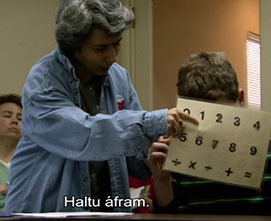 RPM creator Soma Mukhopadhyay shaking a letter board in the face of a subject following an incorrect response. This is a form of punishment known as "facial screening.) The subtitle visible in this frame, "Haltu áfram," is Icelandic for "go on" or "continue." However, it is probably a mistranslation. Mukhopadhyay actually says "Come on!" in an impatient, hectoring manner. (Still frame from Sólskinsdrengurinn, F. Þ. Friðriksson, Director).How are errors corrected in RPM? In the "teach-ask" phase, errors are supposed to be corrected by the facilitator explaining the error, then providing additional opportunities to respond. It is unlikely the verbal explanation has much meaning to most of the subjects, so the function of this procedure is more likely to be to provide the facilitator another opportunity to the guide the subject to the desired response. However, the facilitator may also scold the subject, and, in later stages, use the letterboard to push the subject's hand away when incorrect selections are made, or even shake the letter board in the subject's face. (See right.)
How does RPM protect against or test for "Prompt Dependency?" RPM does nothing to test for or protect against prompt dependency1 (when the subject responds to cues given deliberately or unconsciously by a teacher, rather than to the relevant cues in the environment). RPM facilitators are actually taught that prompt dependency is helpful for establishing responding. But, they are then given no strategies to properly fade and transfer prompts away from them and to the world. They are also provided no methods for finding out exactly what the subject is responding! to.
Does RPM include objective tests to determine whether facilitator or subject is the author of the output?
No. Actually, it's the opposite. Rapid Prompting advocates argue against systematic data collection and testing.
Who invented RPM? RPM is attributed to Soma Mukhopadhyay, a chemist by training, who developed the procedure while working with her son in India. Mukhopadhyay was brought to the United States by Portia Iversen of the Cure Autism Now organization. Rapid Prompting is now formally supported by and disseminate from the "Halo-Soma Institute" in Austin, Texas.
What is the Difference between Rapid Prompting and Informative Pointing? There is no fundamental difference. "Informative Pointing" is a variation of Rapid Prompting associated with Portia Iversen, author of Strange Son, a book about her experiences with RPM and its inventor, Soma Mukhopadhyay.
Is there scientific research supporting RPM? There is no body of scientific evidence supporting the claims that RMP can produce reliable and sophisticated expressive communication in people who are otherwise incapable of it. Given the many similarities between FC and Rapid Prompting, the research exposing the flaws in traditional FC should apply to RPM. The one existing empirical study that seems to test RPM did not actually test whether the subjects were the authors of the output.
Is RPM potentially dangerous? Absolutely. Rapid Prompting has all the same dangers as FC, plus some. It diverts time and resources from effective interventions, carries with it the potential for false allegations of abuse, and could be used to create false consent for sex as happening with FC. Because subject in RPM is not guided directly as in traditional FC, the illusion that the subject is the independent author is enhanced. This is likely to enhance the credibility of statements, and make defense against them more costly and difficult.
Notes
1For instance, a teacher who always looks at the correct answer asks for the child to point to a specific object, and the child simply selects the one the teacher is looking at.
References and Sources
Friðriksson, F. Þ. (Director) (2009). Sólskinsdrengurinn [Documentary movie; aka: "The sunshine boy;" Rereleased as A Mother's courage: Talking back to autism]. Frontier Filmworks in Association with Klikk Productions: Reykjav'k: Iceland.
Iversen, P. (2006). Strange son: Two Mothers, Two Sons, and the Quest to Unlock the Hidden World of Autism. New York: Riverhead Books.
Iversen, P. (2007). The informative pointing method. Unpublished manuscript. Retrieved August 8, 2011 from http://www.strangeson.com/files/Informative_Pointing_Method.pdf.
Lang, R. Tostanoski, A.H., Travers, J., & Todd, J.T. (2014). The only study investigating the rapid prompting method has serious methodological flaws but data suggest the most likely outcome is prompt dependency. Evidence-Based Communication Assessment and Intervention, 8(1), 40-48.
Mostert, M. P. (2001). Facilitated communication since 1995: A review of published studies. Journal of Autism and Developmental Disorders, 31(3), 287-313.
Mostert, M.P. (2010). Facilitated communication and its legitimacy: 21st century developments. Exceptionality, 18(1), 31-41.
Mukhopadhyay, S. (2008). Understanding autism through rapid prompting method. Denver, CO: Outskirts Press.
Tostanoski, A., Lang, R., Raulston, T., Carnetti, A., Davis, T. (2014). Voices from the past: Comparing the rapid prompting method and facilitated communication. Developmental Neurorehabilitation, 17(4), 219-223.
Wombles, K. (2010). Why Rapid Prompting Method Doesn’t Pass the Evidence-Based Test. Retrieved October 7, 2014 from http://kwomblescountering.blogspot.com/2010/04/why-rapid-prompting-method-doesnt-pass.html
Behavior Analysis Association of Michigan, Department of Psychology, Eastern Michigan University, Ypsilanti, MI 48197