


Home • Conference • News • Resources • Science • History • Autism • Bookshelf • Membership • Contact Us
Demonstration of the Effects of Verbal Stimulus Control
The "Clever Hands" Effect
Verbal behavior buffs, try this in class. It shows the power of immediate verbal stimulus control over delayed control by earlier instructions.
This is also an excellent demonstration of unconscious cuing, showing how difficult it is for observers to avoid biasing an outcome despite trying not to.
Directions
Create a series of 20 to 30 "yes-no" questions to be presented verbally. Half should be very easy: "Does a triangle have three-sides?" Half should be so difficult or obscure that no one is likely know the answers: "Did the Baron of Merchiston invent logarithms?"
Shuffle the easy and hard questions. Tell the class to listen carefully and think about each question as it is asked, but then write either "yes" or "no" in response completely randomly, entirely irrespective of the content of the question, trying not to make a predictable pattern of "yes" or "no."
Grade the answers. You'll see about 50% correct for the hard questions and about 75% correct for the easy questions.
All of this occurs despite the previous explicit instructions to the subjects to answer randomly.
The results show how difficult it is for observers to avoid unconsciously biasing their responses based on the contents of the question.
The implications of this effect could not be more clear for "treatments" that claim to establish pointing-based communication in people who are non-verbal, such as "Facilitated Communication," "Rapid Prompting," and "Informative Pointing." It is unlikely that the communication aide or facilitator can simply decide or "will themselves" to avoid controlling the typing of the supposed "communicator."
Reference
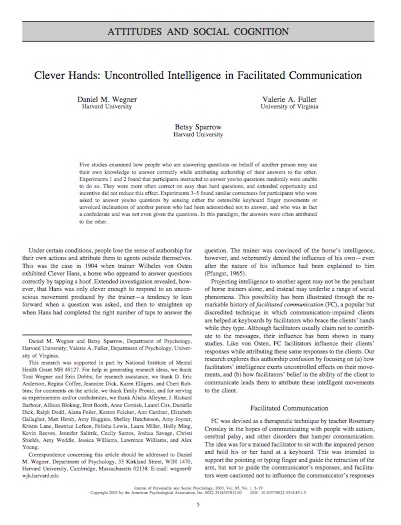
Wegner, D.W., Fuller, V.A., & Sparrow, B. (2003). Clever hands: Uncontrolled intelligence in facilitated communication. Journal of Personality and Social Psychology, 85, 5–19.
Behavior Analysis Association of Michigan, Department of Psychology, Eastern Michigan University, Ypsilanti, MI 48197